This post was first posted on June 13, 2026 (Happy FESTA day, BTS and ARMY. Also, how is 2026 almost halfway done?) and last updated on September 13, 2026.
Because I trained at a traditional residency training program at a government hospital, the details of setting up a mixed private practice felt like uncharted territory. Aside from one or two mentoring sessions, I received zero instruction on the logistics of being a doctor. Medical school should have a practical subject, especially for first-generation doctors.
So this is that post. The first assurance is: it will be okay. The second is: the only time it’s too late is when you’re dead.
This post is divided into three sections.
- What to prepare before leaving residency
- What to accomplish within the first month of “unemployment”
- What to expect after six months of setting up
Disclaimer: this blog comes from personal experience. This is not meant to be a definitive or 100% accurate guide. Personal realities will differ depending on individual professional goals. I still hope I can help ease some of the confusion.
This also does not include any expenses or preparations made for specialty board certification.
Thank you to helpful government agency websites (rarer than you’d already expect), my friends, my family (especially my sister for letting me live rent-free in her condo and her brain), and other bloggers for their tips as well!
Before leaving residency
Planning is the enemy of panic. Space out these tasks.
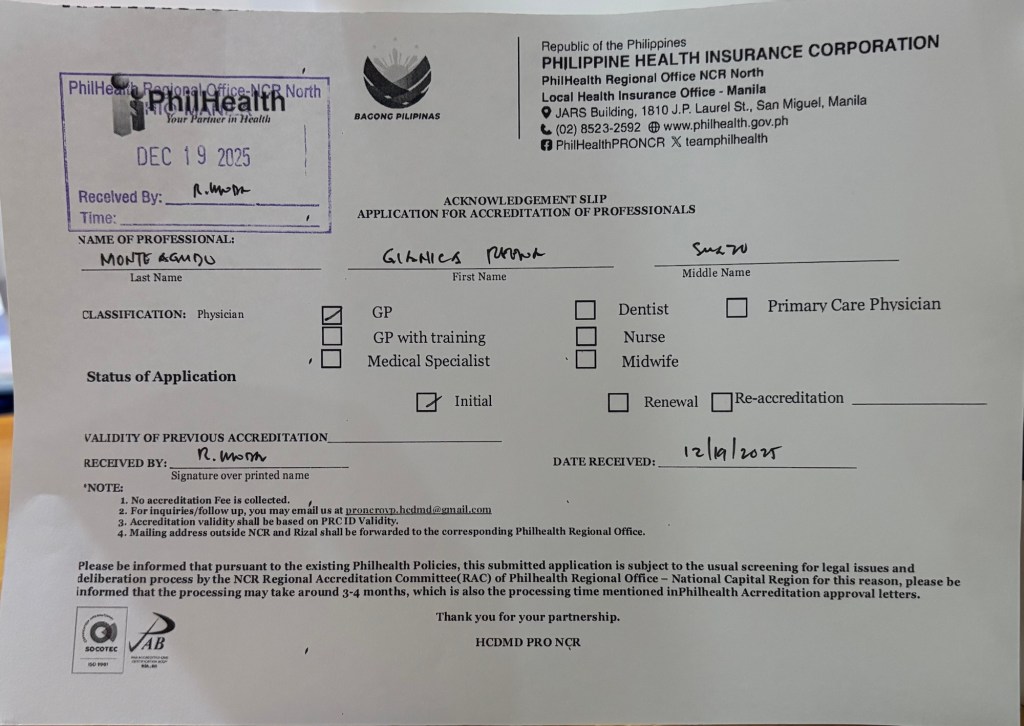
1. PHILHEALTH ACCREDITATION PROCESS AS A HEALTH CARE PROFESSIONAL
As a resident trainee in a government hospital, professional fees under PhilHealth are pooled and distributed among health care personnel by the powers-that-be. But as an independent practitioner, provider accreditation is required to participate in the National Health Insurance Program. This status means you can receive professional fees, and your patients can claim PhilHealth benefits during admission or consult.
Not all private companies will require this. However, most large institutions and medical networks who participate in PhilHealth benefits will require this for professional fee sharing –whether for inpatient admissions or emergency room consults.
The type of accreditation (GP, GP with training, or specialist) can determine how much you get as professional fee during an admission. But for the purposes of initial accreditation, it’s okay to apply as a ‘General Practitioner’. The status can be updated later on, though I hear the process is similarly as tedious.
How to apply: PhilHealth has a list of documentary requirements available online, which includes the following:
- Provider data record
- Performance commitment – signed and notarized
- PRC license copy
- Passport-sized photos
- Certificate of good standing (COGS) from PMA and component society
- Proof of contribution as PhilHealth member
These documents are then submitted to a local health insurance office for processing.
Cost of application: ₱200-500 for notarization. Possible additional costs: payment of society dues (₱3000+) to secure COGS, if not yet updated. Payment of PhilHealth member contributions (e.g. ₱500 per month unemployed).
Processing time: 2 to 3 months. You’ll receive your ID number via e-mail. You can also access accreditation history and other details by creating an account at https://partners.philhealth.gov.ph/portal/home.php
Why apply during residency: If you apply while employed, you can easily request a certification of PhilHealth contributions from your employer.
And though the application itself takes only a day or two, the approval and release of the accreditation number takes 2 to 3 months. 😭 This represents time that you could have been earning more appropriately for admissions or consults.
This gross delay is one of life’s greatest mysteries. To have an accreditation number on hand by January, I suggest apply as early as October. I applied near the end of December, and got my accreditation number near the end of February. It took exactly 40 working days.
Follow-up of status can be done via the PhilHealth action center hotline and by seeking assistance from accresup.hcprofsid@gmail.com. I remember only receiving an automated reply.
2. PREPARE AS MANY GOVERNMENT-ISSUED AND CREDENTIALING DOCUMENTS AS POSSIBLE
If you have a birth certificate, passport, and driver’s license, you’re set. You need at least one government-issued ID which includes your address to facilitate residential address registration (for tax purposes). The easiest alternative to a driver’s license is a PhilHealth member ID.
For future job applications, the minimum requirement is usually PRC license, updated CV, and TIN. Others may require PTR, PhilHealth provider number, sales invoice. For more permanent posts, clinic admins usually ask for other proof of credentials, including medical school diploma, certificate of residency, and references (more on that below).
3. SET ASIDE BUDGET FOR DOCUMENT-RELATED ERRANDS AND MISCELLANEOUS EXPENSES
Government separation pay can end up being generous and enough to get a practice started, especially for those coming from four-year or five-year residency training programs. The true villain is the notoriously slow process of clearance and accounting.
Aside from setting aside funds to cover living expenses, other projected expenses include:
- Membership dues in medical societies. This can cost ₱1,500 per year for PMA and another ₱1,500+ for the component society. Then, the specialty society is another ₱1,500 per year. These are all necessary to obtain certificates of good standing.
- Uniform allowance. Some (but probably most) private institutions will frown upon wearing scrubs and white coats with logos from your previous hospital. A long white coat can range from ₱1,800 and above, while quality scrub sets run around ₱1,000 to ₱4,000 (crazy).
- Continuing medical education activities. PRC now requires 30 CPD credit units for 2026, and 45 units per year starting 2027. This is still pretty vague to me, but it sounds expensive already.
This doesn’t include the logistic costs of commute or hailing a GrabCar when running errands. Last week I had to go to Eton Centris in Quezon City just to pickup my PRC Certification of Registration, which is different from the board certificate / certificate of rating. The original copy can only be claimed from the PRC branch where you first applied for your license. Yes, I got mine 5 years late.
Within the first month of unemployment
Lie around in bed feeling thankful for having completed residency, then go back to work once the bills start piling up…
1. SECURE CLEARANCE FROM YOUR INSTITUTION
Clearance from your government residency training program is needed to request for a copy of certificate of training or residency training diploma. Clearance is also needed if taking up another post in a government institution.
For our institution, clearance process starts with answering an exit interview tool, submitting forms for separation pay and benefits, and returning the identification cards. The hard and tedious part is going around different divisions of the hospital to have the form signed.
Estimated processing time for clearance: 2 to 3 months. Separation pay can take longer, usually up to 5-6 months.
But personally, my clearance took up to 5 months to process, even though I didn’t have any major outstanding requirements or deliverables pending. I only got my Certificate of Residency last week… I still don’t have my sep pay. Curse bureaucracy!!!
Bonus horror story: I got stopped by an Immigration Officer on my way to Melbourne for a girls’ trip, because they were looking for my (then-non-existent) clearance form. Better to over-prepare documents!
TIMELINE AND PROCESS UPDATES:
— I received my “Termination Leave Benefit” from PGH during the first week of September — four months after clearance. TLB is the commutation or conversion to cash of accumulated earned vacation and sick leave credits. It was such a tiresome and unnecessarily delayed process. Bulk of it was from HR sitting on the papers for no good reason before forwarding them to Accounting/Payroll et cetera.
— I received a Cash Surrender Value for Life Insurance Policy from GSIS last July 2026 by snail mail. I proceeded to the GSIS Pasay City Main Office to claim the check. To clarify, only life insurance can be claimed; GSIS separation benefits can really only be claimed upon retirement. Requirement: bring two valid IDs.
— I applied for the refund of my contributions plus withdrawal of any earnings from the UP Provident Fund via the online portal. Requirement: copy of my service record and employee’s clearance.
2. PAY PROFESSIONAL TAX AND GET YOUR PTR
Licensed professionals (physicians, nurses, accountants, et cetera) need to pay professional taxes every year. This is done annually after licensure exams and certification. As a legal requirement, the professional tax receipt is also requested by some employers.
Working at a government residency program exempts you from paying this tax. However, you need to apply for one as soon as you’ve resigned or quit before January 31 of that year in order to avoid penalties.
How to get your PTR: Proceed to your local municipal or city Treasurer’s Office. The process in Parañaque City took around 10 minutes or less.
Cost of payment for PTR: ₱300 for initial PTR after passing the licensure exams or after graduating from a public residency training program. If the payment is delayed, there is a surcharge of +25% plus 2% for every month of delay. This can reach thousands if not properly explained.
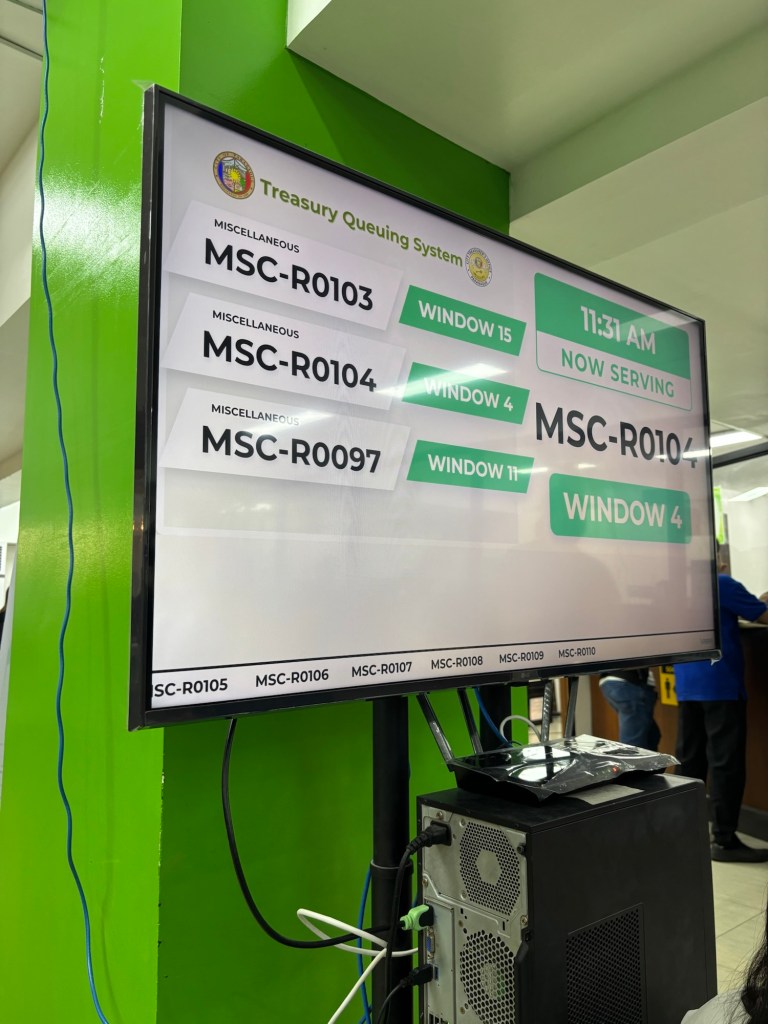
3. REGISTER AT THE BIR AS A PROFESSIONAL AND SETUP TAXES
Paying taxes is a legal obligation of any working citizen. Unfortunately. A certificate of registration (COR) as a self-employed professional, as well as a service invoice (receipt booklet), are required by many clinics or hospitals.
Applying through the BIR office closest to your permanent address will definitely take several business days. I personally skipped the hassle and opted to contract an accounting firm. Following the recommendation of friends, I chose Better Practice Consulting. Correspondence is easy through e-mail. I also like their dedicated mobile app.
Interested? Use my referral code GSM4600 to get P1,000 off your first tax filing! Check it out here: https://mdcs.page.link/s15S
Requirements for Basic Registration (for Residential Address): The requirements can be found through the BIR website. The documents I personally prepared to be processed by Better Practice include the following:
- PRC ID copy
- Valid ID with address copy
- PTR copy
- Official receipt layout form
- Layout of intent to avail the 8% flat income tax return
- Specialty diploma/certificate, if with additional acronyms to trade name
- Marriage certificate, if applicable
- Barangay certificate
- Residential affidavit of non-rental
- Proof of ownership copy
- Photocopy of valid ID belonging to person named in proof of ownership
Since I transacted through a representative, I also prepared a Special Power of Attorney.
Cost of registration: As per the BIR website, the primary cost is only a Php 30 Documentary stamp tax (DST). However, since you also buy books of accounts (Php 50/book, for a total of 6 books), official receipts (Php 2,000 for 10 booklets), notarial fee if needed, and so on, the cost can add up to Php 3000.
The standard plan of Better Practice (for non-training doctors) cost Php 2,999 per quarter and an additional Php 2,999 billed every January. The direct costs of registration are already included. I think the first two quarters are waived.
Processing time: The Better Practice website says processing takes 1-2 months. I submitted my complete documents at the end of January via courier. I received my documents and had an orientation to bookkeeping around the second week of April, so that took about 2-3 months for me.
I’ve filed my first quarter ITR and invoice already, and it was a very smooth process. The more likely cause of delay would be the clinic admins/HR taking their time in providing the tax return form.
After six months
Blessed are the doctors and specialists who are inheriting a private practice, or proceeding to subspecialty training, or shifting out of the industry entirely. For most first-generation doctors, even those from well-connected training institutions, the first six months is a time of uncertainty.
Where will you hold your clinic? How can you sustain your lifestyle? How do you adjust from a regular salary job (with mid-year bonus, PhilHealth shares, and 13th month pay) to a pay-per-service or pay-per-duty life?
Unless you take up a particularly lucrative specialty, surviving the first year out will depend on your connections and your ability to get high-yield duties.
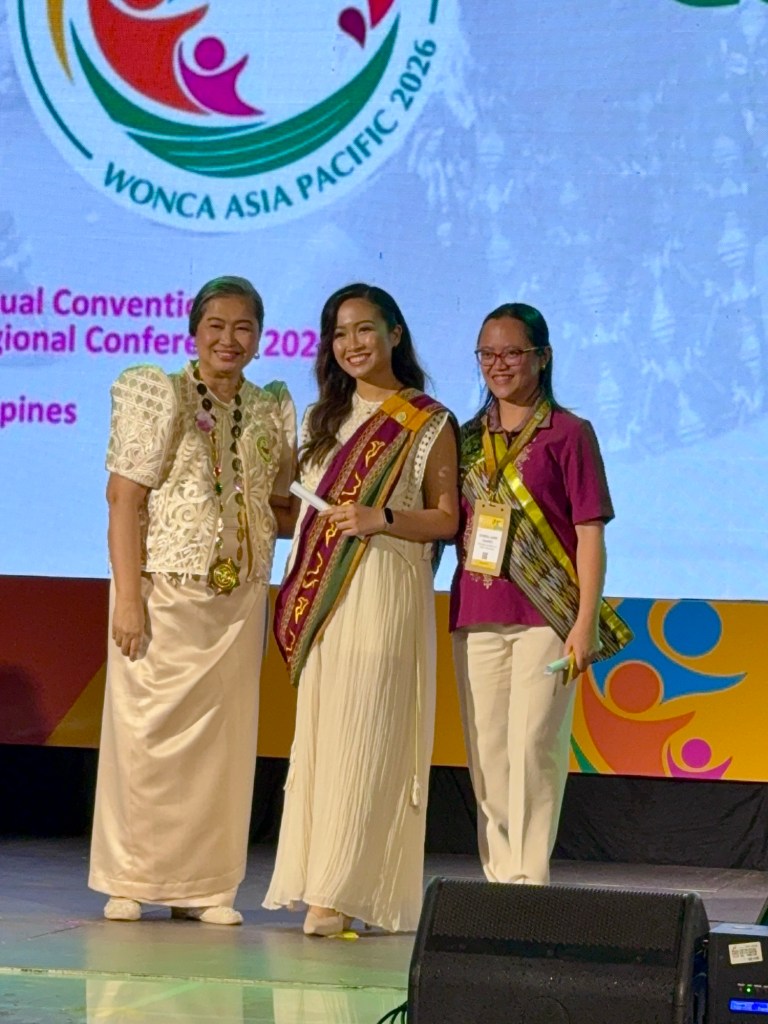
1. WHERE TO GET JOBS AND DUTIES
- Connections. Residency supplies you with connections, and from there, you should be able to get referrals. One of my first locum posts was from a recommendation from a friend. I’ve since been honored to be invited by my senior consultants and mentors to several hospitals for clinic work (but usually teaching duties with clinic privileges), but unfortunately the timing or logistics haven’t lined up. I didn’t want to say yes and just end up compromising other parts of my life in the long term.
- Direct application. I directly applied for my other clinical duties. It’s tedious, and there are so many requirements every time, but it can be worth it. So be sure to prepare basic credentials ahead of time (CV, PRC ID and certificate, internship certificate, medical school diploma, certificate of residency, board certification, BLS and/or ACLS certificate, references, and possibly immunization record/titers). Personally, I only applied to clinics I had some personal or near-personal knowledge of, such as from my time as a patient or intern.
- Online groups. I’ve also joined several moonlighting and job posting groups online. At the very least, it’s good to have an idea of the going pay rate and follow any discourse over benefits and challenges associated with some employers/clinics.
I think the best tip is to prepare extra grace for yourself. My mom and my sister, on the other hand, would rather advise that you just prepare extra savings.
2. HOW TO DEAL WITH “ATTENDING ANXIETY”
I’ve had several instances of what I now call “attending anxiety” —the apprehension, worry, doubt, and overthinking that all come with the fact that you are now sometimes the last say in clinical orders as a junior consultant or attending physician.
Some things I’m trying to keep in mind to help reduce this anxiety:
- Never be afraid to ask or to search. It’s important to know what things may be common sense and should be base knowledge, and what things may be out of your expertise. What lessons you take in by necessity now, can and should be applied in advance later.
- Treat patients as partners (and as people). Communication skills can really go a long way, even in acute care settings. Shared decision-making is key. And for both your sakes, documentation of dialogue is also key.
- Take it one day at a time. I’ve felt acute stress more frequently in the last few months than I’ve felt in the last five years, which is saying something, but the same comforting thoughts run through my brain as they did in college and clerkship. The sun will always rise tomorrow. There’s always an opportunity to improve.
- Remember that you are not alone. The moment I was going through a rough patch, I took several deep breaths, wrote about it in my journal, and found some time to share my thoughts and feelings to my support system. It was a comfort to know that this feeling and these experiences are not unique to me; we all go through the same transition. And a problem shared is a problem half-solved.
Where to next…
I wanted to write this blog post for residency seniors entering their last few months of training, and even for juniors just starting out (as Stephen Covery says, BEGIN WITH THE END IN MIND). I’m also writing this for myself, to document with some clarity this challenging time.
Related Blog: Where to begin — 2026
Be guided by purpose. Unfortunately that’s still sometimes a little unclear for me, aside from having enough time and money to afford my travel and art hobbies. But take comfort in the fact that experience will eventually teach and guide you.
At the very least, months of mostly clinical work have helped me refine my idea of a good life. I still don’t want work that can keep me out for more than 12 hours. I want work hours that will let me cook good food and go to cafes and continue going to the gym. I can’t do purely clinical duties; I need to contribute something to knowledge and growth. Eventually, and by eventually I mean hopefully next year, I want to have a part-time government post to help secure my pension (ha!) and my desire to be part of the academe/training. The exact specifics still escape me, but it’s okay. I have time.
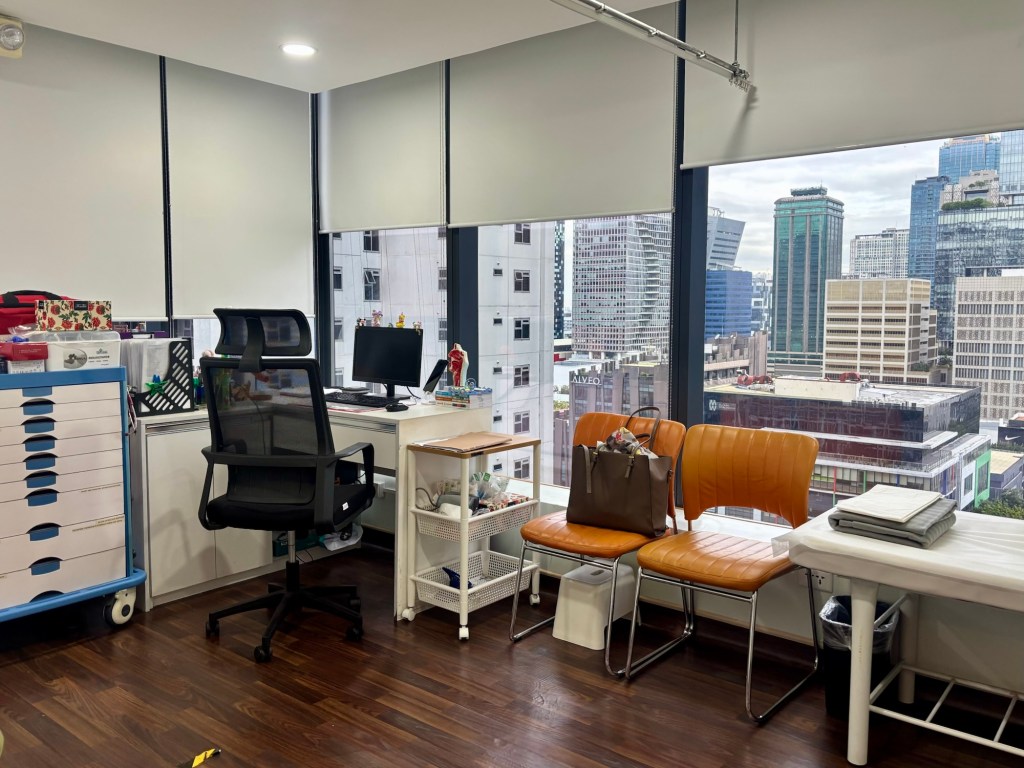
I also want to keep working in places as pretty as these (aka some of the clinics I go to in BGC). Goodbye for now, Manila.
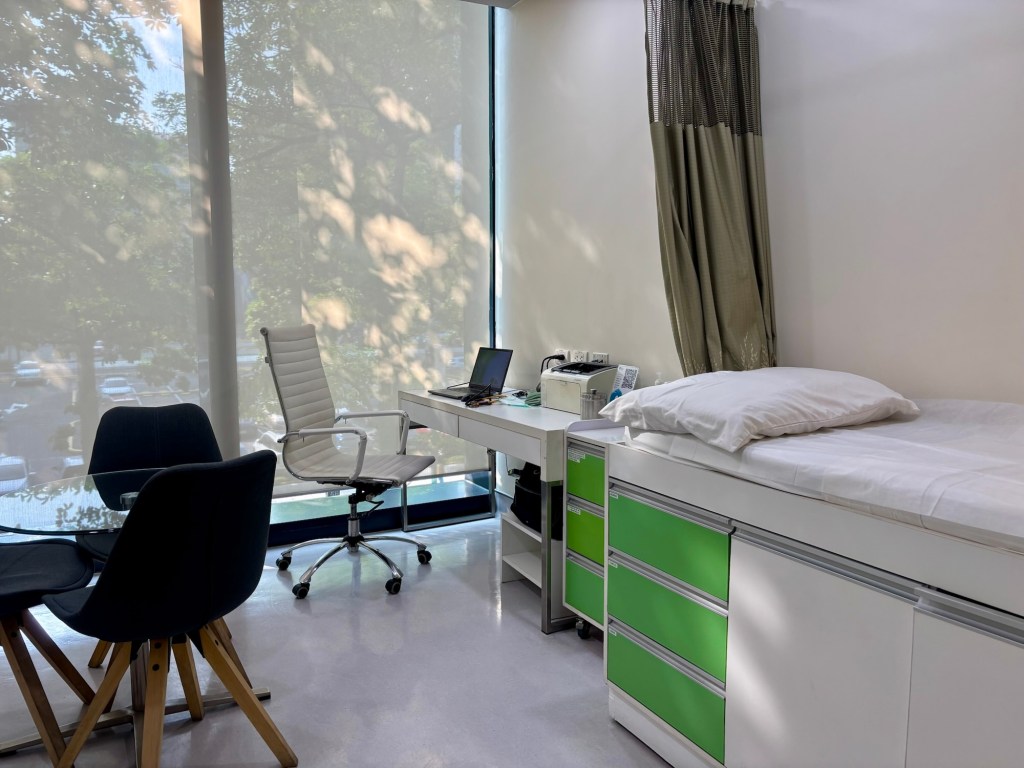
Right now, I’m prioritizing settling down in Makati —I just moved out of Manila and I’m done staying at our BGC condo. My next posts will probably be overdue travel vlogs, moving in adventures, and life in Legazpi. There’s MoCAF next month. I also have a new niece (a very belated update to this blog), whom I’m looking forward to meeting again in a couple of weeks.
In between these moments: work, rest, doubts, gym training, good coffee. Everyone goes through the same phases in life, only in different paces and flavors. Hopefully this post can help even a little bit.
Until next time! 🖤 And good luck!


Say something back.